
California’s Statewide Rent Cap Explained: What AB 1482 Really Requires (and Who’s Exempt)
California’s Tenant Protection Act of 2019 has governed rent increases and many tenancy terminations across the state since 2020. Here’s what property owners, investors, homeowners, and tenants should know about AB 1482.

AB 1482 applies to much of California’s rental housing, but important exemptions and local rules can significantly change how the law applies.
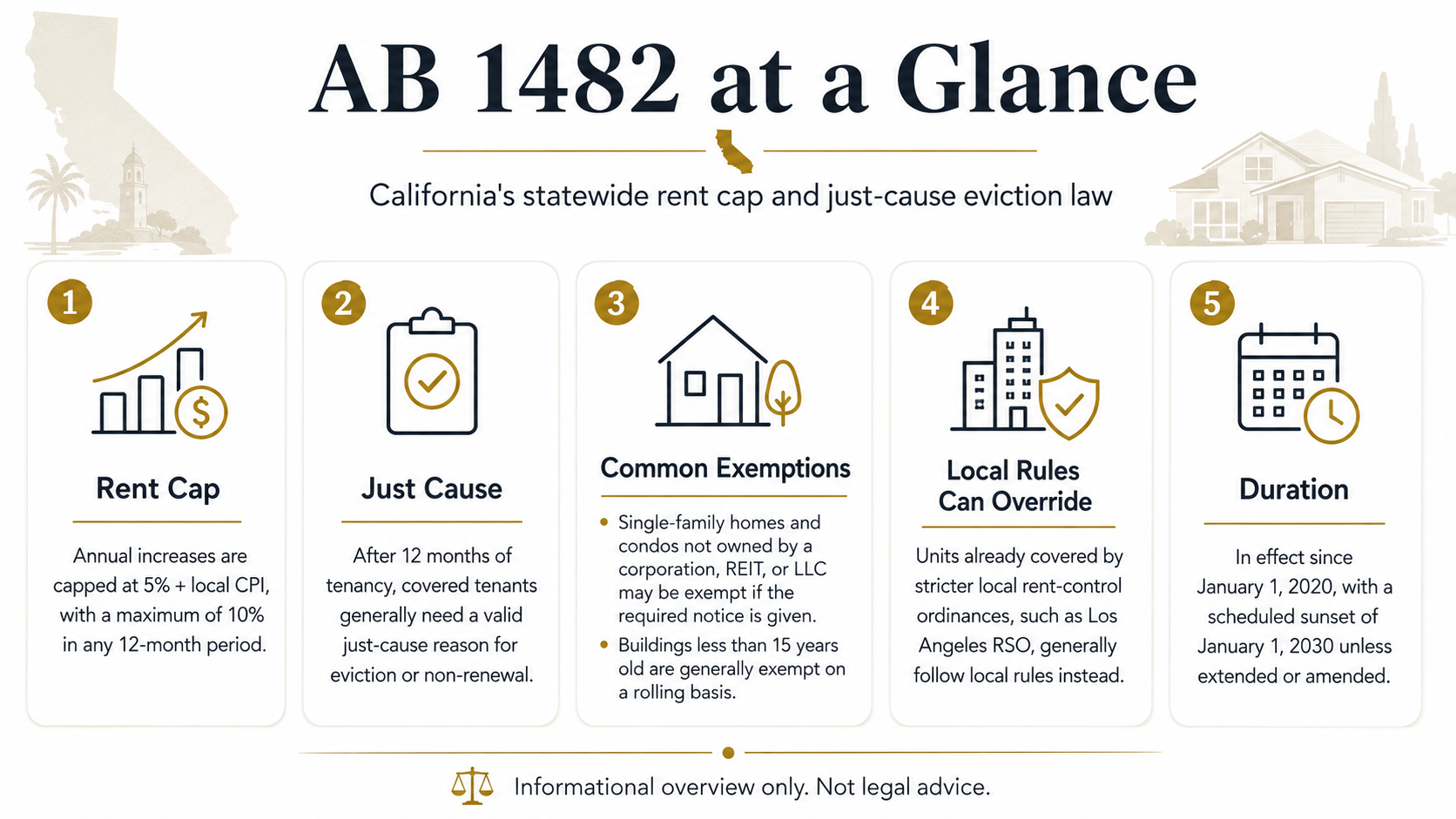
If you own, manage, rent, or are shopping for property in California, chances are AB 1482 already affects you — even if you’ve never heard the name. Formally known as the Tenant Protection Act of 2019, this state law has governed rent increases and evictions for much of California rental housing since January 1, 2020. Unless it is extended or amended, it is currently scheduled to remain in effect through January 1, 2030.
AB 1482 in one sentence: It generally caps annual rent increases on covered units and requires a valid just-cause reason to terminate many tenancies after the tenant has been in place for 12 months or more.
AB 1482 at a Glance
What the Law Actually Does
AB 1482 does two main things:
- Limits rent increases on covered properties.
- Requires just cause for many terminations once the tenant has lived in the unit for 12 months or more.
The annual rent increase limit is generally 5% plus the applicable local Consumer Price Index (CPI), with a hard ceiling of 10% in any 12-month period.
Just-cause reasons are generally divided into two categories:
- At-fault reasons, such as nonpayment of rent or a material lease violation.
- No-fault reasons, such as certain owner move-in or substantial-remodel situations, which generally require relocation assistance.
In 2024, SB 567 tightened parts of the owner-move-in and substantial-remodel rules and expanded enforcement authority.
Important Exemptions
The law applies broadly, but not universally. Common exemptions include:
- Single-family homes and condos not owned by a corporation, REIT, or certain LLCs, as long as the required written notice is provided.
- Buildings less than 15 years old, measured on a rolling basis.
- Units already covered by stricter local rent-control ordinances, which generally follow the applicable local rules instead.
Los Angeles owners should pay particular attention to local law. If a unit is covered by the City of Los Angeles Rent Stabilization Ordinance or another local tenant-protection ordinance, those rules may be more restrictive than AB 1482.
What Supporters Say
- It helps prevent sudden rent spikes that can destabilize tenants and neighborhoods.
- It gives tenants a baseline level of protection against arbitrary or retaliatory evictions.
- It fills a statewide gap for renters in cities that do not have their own rent-control rules.
- Relocation assistance for no-fault terminations can soften the financial impact of a forced move.
What Critics Say
- Some argue the 5% + CPI formula, capped at 10%, often functions more as an anti-gouging measure than traditional rent control.
- Industry groups argue that additional restrictions on rental housing can discourage investment and construction.
- Some economists point to a “lock-in” effect, where tenants become reluctant to move even when their housing needs change.
- Some tenant advocates argue the law still leaves too many exemptions in place.
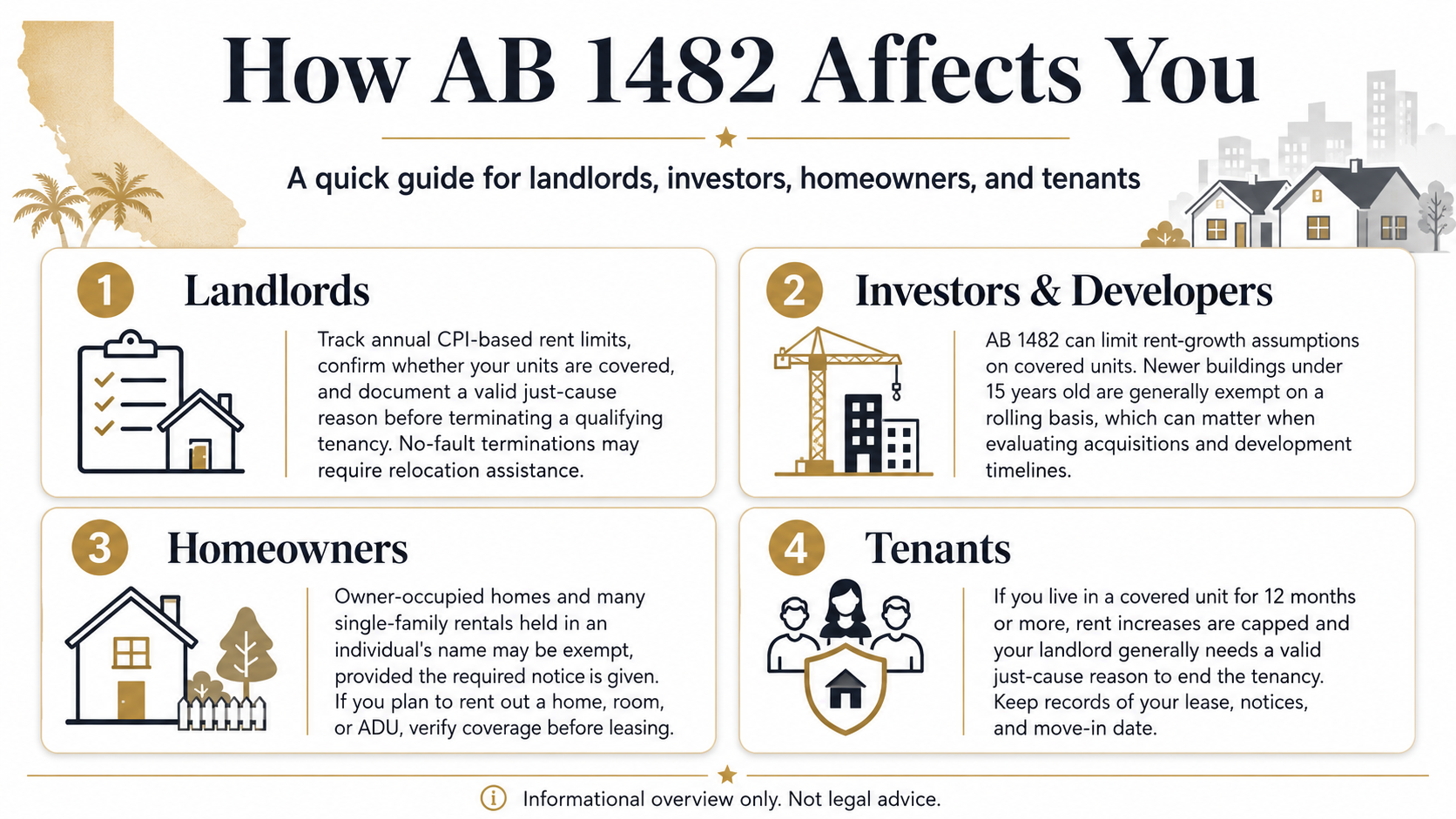
How AB 1482 Affects You
Existing Landlords
If your units are covered, you need to track the applicable CPI-based rent cap each year, confirm the property’s coverage status, and document a valid just-cause reason before terminating a qualifying tenancy. No-fault terminations may require relocation assistance.
Since SB 567, owner-move-in and substantial-remodel terminations also carry more detailed requirements and potentially greater legal exposure if the termination is challenged.
Investors and Multifamily Developers
AB 1482 can affect underwriting assumptions because annual rent growth on covered units is limited. The rolling 15-year exemption for newer construction can be particularly important when evaluating acquisitions, repositioning strategies, and development timelines.
Investors purchasing single-family rental properties should also pay close attention to ownership structure because the exemption rules can depend in part on how the property is owned.
Regular Homeowners
If you own and occupy your home, or own a qualifying single-family rental in your own name and provide the required notice, AB 1482 may not apply. But if you plan to rent a room, ADU, or second property, it is worth confirming whether that rental will be covered before signing a lease.
Tenants
If you live in a covered unit for 12 months or more, your rent increases are capped and your landlord generally needs a valid just-cause reason to terminate your tenancy. Keep records of your lease, notices, move-in date, and rent-increase history.
Bottom Line
AB 1482 has become a major part of California’s rental-housing landscape. Whether you are a landlord, investor, homeowner, or tenant, it is important to understand both the statewide rules and the exemptions. In cities with stricter local tenant protections — including Los Angeles — local ordinances may still be the most important layer of regulation.
Disclaimer: This article is for general informational purposes only and is not legal advice. Landlord-tenant rules can be highly fact-specific, and local ordinances may change how statewide law applies in a particular situation.
Leave A Comment